Principal Investigator
Alison Gopnik, PhD

Dr. Alison Gopnik, then and now
My research explores how young children come to know about the world around them. The work is informed by the "theory theory" -- the idea that children develop and change intuitive theories of the world in much the way that scientists do. Most recently, we have been concentrating on young children's causal knowledge and causal learning across domains, including physical, biological and psychological knowledge. In collaboration with computer scientists, we are using the Bayes Net formalism to help explain how children are able to learn causal structure from patterns of data, and we have demonstrated that young children have much more powerful causal learning mechanisms than was previously supposed.
email | website
Lab Manager
Maansi Narain

Maansi Narain, then and now
Hi! I’m the lab manager for Dr. Alison Gopnik’s lab. In 2024, I earned my B.S. in Developmental Psychology from UC San Diego, where I was part of several labs studying cognitive development and language. I am currently interested in studying how children explore the world around them, how they understand time, how they acquire language, and the role of imagination in childhood development. I hope to study some of these topics further in graduate school. For now, I’m excited to work with and learn from the incredible members of the Gopnik Lab.
email | linkedin
Post Doctoral Researchers
Melis Muradoglu, PhD

Dr. Melis Muradoglu, then and now
I study how our knowledge about our academic and social worlds is organized around more general, informal principles called intuitive theories. I aim to characterize the contents, structure, and developmental trajectory of these intuitive theories, and to identify the aspects of them that are common across and variable between individuals. Part of this work attempts to understand how these general principles in the academic domain intersect with individual differences in motivation. In the Gopnik Lab, I am studying children’s intuitive understandings of caregiving relationships.
Eunice Yiu, PhD

Dr. Eunice Yiu, then and now
I study how children make sense of and explore objects in their everyday lives, with a focus on the mechanisms that support abstract generalization and exploration. My current work asks: How do children develop the ability to move beyond specific observations to form broader, generalizable inferences, and how can their cognitive developmental trajectories inform benchmarks for current vision–language models? What intrinsic motivations (e.g., information gain and empowerment) guide children’s exploration of novel environments, and how might these signals be adapted to improve reinforcement learning agents? By comparing children’s learning strategies with those of adults and AI systems, my research aims to uncover principles that optimize discovery and reasoning in both humans and machines.
email | website
Doctoral Students
Annya Dahmani, 4th Year

Annya Dahmani, then and now
My research is at the intersection of cognitive science and artificial intelligence. I am especially interested in how we can build artificial intelligence that draws directly from human cognition, particularly in the areas of learning, exploration, and reasoning. I take inspiration from decades of research showing how humans, specifically children, are able to learn so much about the physical and social world so rapidly and flexibly. Yet, there are certain things that young children can do that are still very far from anything that current state-of-the-art AI can do. During my PhD, I aim to leverage experimental and computational approaches to better understand the connection between learning, decision making, and reasoning.
email | website

Fei Dai, 3rd Year
I’m interested in understanding how children make sense of the world as a flexible learner. Questions I hope to address in my research include: How do children build causal models of the world? How do children effectively generalize prior experiences to novel situations? What cognitive mechanisms shape their exploration and learning? And lastly, how does the learning process of artificial agents diverge from that of children, and what insights can we draw from children's learning strategies to create more human-like artificial intelligence?
Thank you to our undergraduate research assistants!
Caroline Simmons
Verena Ghobrial
Monica Mok
Ava Pourasgari
Ray Huang
Cassandra Orr
Nicole Montes
Jennifer Liu
Kaydee Manikhong
Lindsay Martin
Sam Yuan
Janna Umagat
Elle Anhut
Maggie Kwee
Danica Hartawan
Thank you to our 2026 summer internship cohort!
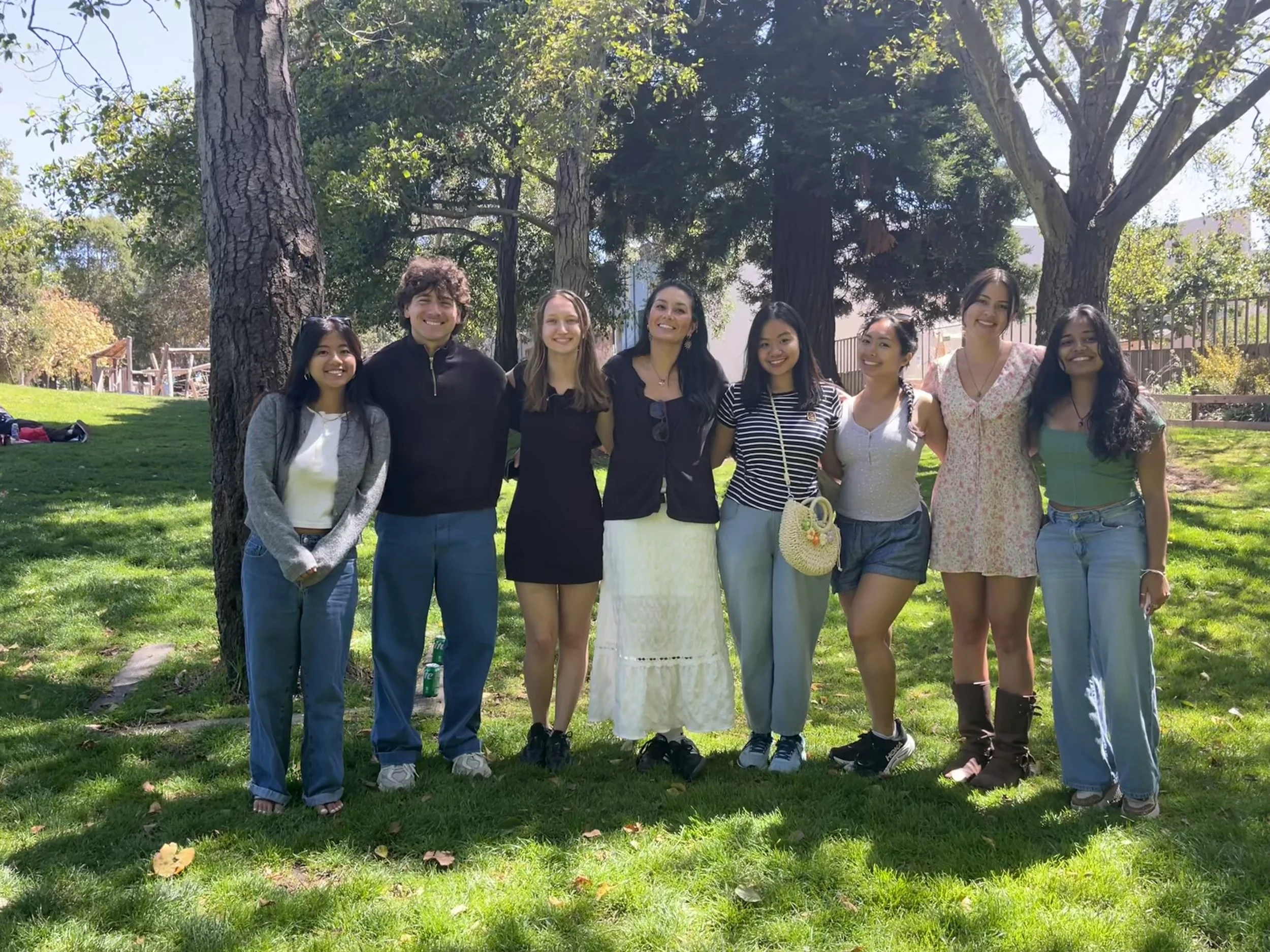
From left to right: Amy Nguyen (Dickinson College), Anthony Cirillo (UC San Diego), Sophia Visconte (Brown University), Sophia Roth (UC San Diego), Tran Le (Cornell University), Brianna Guinigundo (University of Central Florida), Olivia Falk (Brown University), Maansi Narain (Lab Manager)
Thank you to our 2025 summer internship cohort!
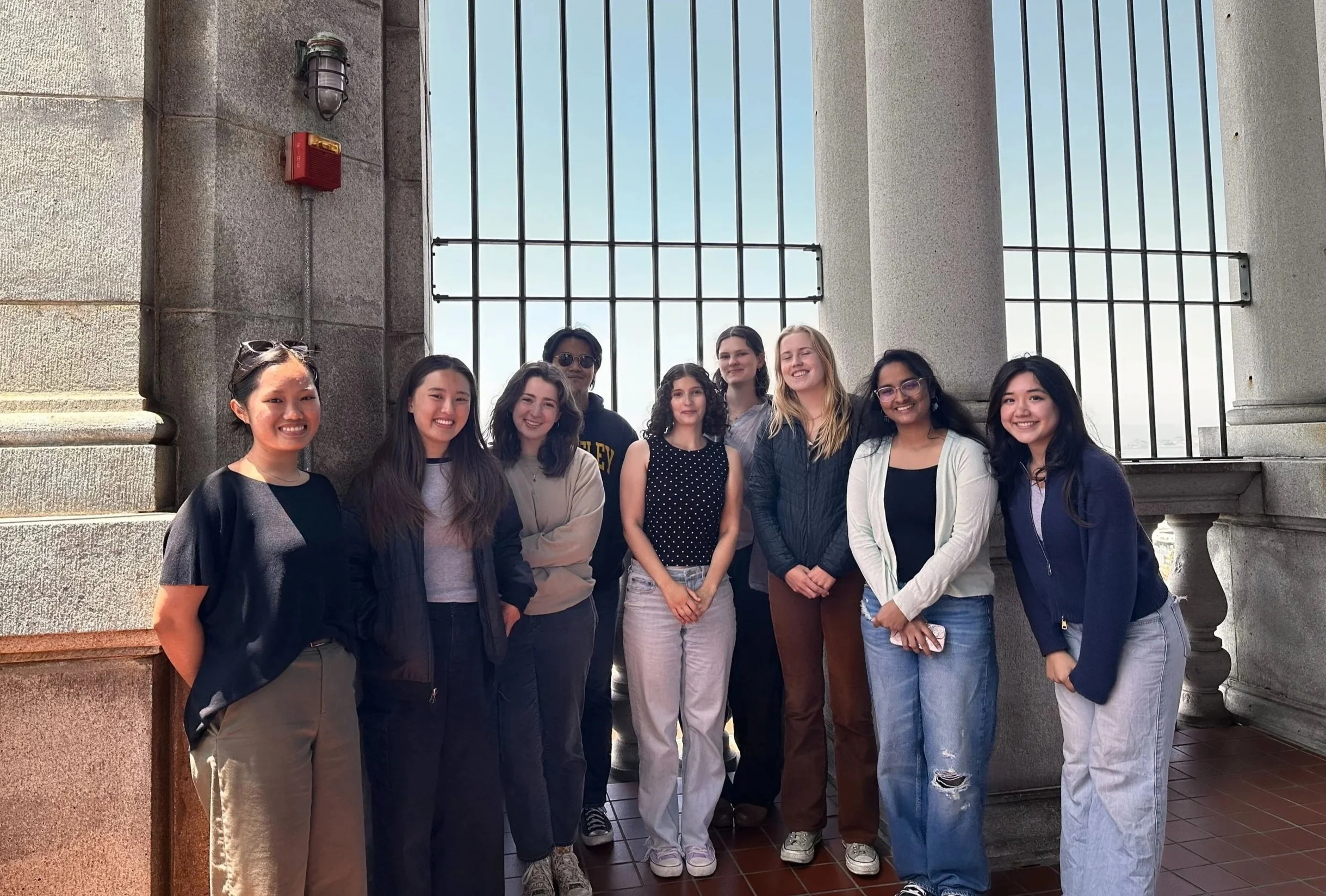
From left to right: Janna Umagat (UC Berkeley), Christine Kwon (UC San Diego), Audrey Schwartz (Carleton College), Ray Huang (UC Berkeley), Dalia Levanon (Williams College), Eva Laborde-Turner (McGill University), Hannah Bernhardt (Williams College), Ashwini Kumble (University of Wisconsin-Madison), Kiara Lizarraga (UC San Diego)
Thank you to our 2022 summer internship cohort!

Thank you to our 2021 summer internship cohort!

Recent Lab Alumni
DR. LAURA LEWIS was a postdoc in the Gopnik Lab and Social Origins Lab, and was awarded the UC President’s Postdoctoral Fellowship. Fascinated by the evolution of great ape social cognition, her research explores how humans and our closest living phylogenetic relatives, chimpanzees and bonobos, have evolved to recognize, remember, and represent one another. Dr. Lewis is now a professor at University of California, Santa Barbara, where she leads the Biological Origins of Mind Lab.
DR. ELIZA KOSOY earned her PhD in the Gopnik Lab studying the intersection of artificial intelligence and child development. She studied this in two different domains: intersections with Brenden Lake's work on one-shot-learning and Omniglot and through curiosity and exploration with various faculty at BAIR. Dr. Kosoy now works on AI research at Character.AI.
DR. JOSH RULE was a postdoc in the Gopnik Lab who used behavioral experiments and computational methods to study how people develop conceptual systems and leverage them to accomplish their goals, with his work revolving around the idea of the child as a hacker.
ROSE REAGAN was the Gopnik Lab Manager for four years, during which she kept the lab running, supervised RAs, and conducted independent research in the realms of social causality, analogical reasoning, and AI capacities. Rose is now a PhD student at the University of California, San Diego working with Gail Heyman and Caren Walker.
DR. NY VASIL was a postdoc in the Gopnik Lab exploring how explanation and causal reasoning contribute to learning, inductive inference, and decision-making, and how this relationship varies with context, domain-specific experience and development. Dr. Vasil now leads the Cognitive Development (CoDe) Lab at California State University East Bay.
DR. DORSA AMIR was a postdoc in the Gopnik Lab investigating how preferences and decision-making vary across diverse cultures, with an emphasis during her time here on caregiving. She is curious about how differing cultural and ecological environments shape the developing mind. Dr. Amir now leads the Mind & Culture Lab at Duke University.
DR. REBECCA ZHU earned her PhD in the Gopnik Lab investigating how children acquire and learn from symbolic systems, such as language and pictures, and then completed a postdoc with Drs. Gopnik and Engelmann studying related questions. Dr. Zhu is now a postdoc at Stanford University working with Dr. Michael Frank.
DR. BENJAMIN PITT was a postdoc working with Drs. Alison Gopnik, Steve Piantadosi, and Ted Gibson (at MIT). Ben’s research investigates how people use the structure of space and language to represent abstract conceptual domains like time, number, and emotion. Dr. Pitt is now a postdoctoral fellow at the Institute for Advanced Study in Toulouse.
DR. MARIEL GODDU earned her PhD in the Gopnik Lab and went on to complete a postdoc studying play behavior in collaboration with Drs. Tomer Ullman and Elizabeth Bonawitz at Harvard University. Mariel is currently an Alexander von Humboldt postdoctoral fellow at the Centre for Advanced Study in the Humanities: "Human Abilities" & the Institut für Philosophie, Freie Universität Berlin. She plans on attending Stanford University for a PhD in Philosophy.
DR. EMILY LIQUIN earned her PhD in 2021 and was co-advised by Alison Gopnik and Tania Lombrozo at Princeton University. Dr. Liquin is currently a postdoc working with Dr. Todd Gureckis at New York University.
EMILY SARAH SUMNER: I was a postdoctoral researcher working with Alison Gopnik and Celeste Kidd. My research investigates how children make decisions and explore the world. Specifically, I am interested in how children's independent exploration can be beneficial to their psychological development. I use a combination of behavioral and computational methodologies to do this. I am a supporter of open science. More information about my research can be found on my personal website, www.emilysarahsumner.com Dr. Sumner is now a researcher at Toyota Research Institute. She continues to collaborate on a line of research investigating exploration and altruism in kids.
KATIE KIMURA: My research interests, broadly defined, are informed by two closely related questions about conceptual development: 1) how do children acquire abstract knowledge, such as complex causal relations, and 2) once children acquire this knowledge how does it interact with their existing beliefs to revise their theories about the world and facilitate the acquisition of new concepts? My work thus far explores abstract knowledge from the perspective of categorical relational learning and word learning (e.g., number word learning and adjectival word learning). Future work, however, will continue to expand upon these questions by examining other kinds of abstract knowledge including causal reasoning. Dr. Kimura received her PhD in 2020.
TERESA GARCIA: Over the last 7 years, I have spend my time working as a preschool teacher, research assistant, psychology student, and lab manager. All of these experiences have taught me a lot about children's learning and development and have motivated me to keep on learning more so that I can one day apply my knowledge to help children, parents, and teachers create environments where we can help our preschoolers be good helpers, teachers, and learners. Teresa Garcia was an undergraduate RA and then served as our Lab Manager. She is now the Lab Manager at Stanford’s Social Learning Lab.
SHAUN O’GRADY: Hi, my name is Shaun, and I am interested in learning more about the development of social cognition. I study how young children reason about other people’s actions, thoughts, and emotions. I would also like to investigate how these reasoning abilities change over time to allow children, adolescents, and adults to navigate increasingly complex social interactions such as communication, pedagogy, and joint action.
ADRIENNE WENTE: My research focused on how children develop an understanding of every day causal events in the world, both social and physical. I was interested in the interaction between innate constraints on conceptual development and cultural learning processes. I was working on a series of studies that compare Berkeley children to children in China. These studies explore the development of causal attributions for social and physical events and the development of beliefs about free will. I also worked on a series of studies exploring the relationship between culture, learning, and early education curriculum in Peru and the U.S.
ELIZABETH BONAWITZ: My research bridges two research traditions: Cognitive Development and Computational Modeling. By bridging these methods, I hope to understand the structure of children's early causal beliefs, how evidence and prior beliefs interact to affect children's learning, the developmental processes that influence children's belief revision, and the role of social factors (such as learning from others) in guiding learning. Current webpage here.
Dr. Bonawitz worked as a post-doctoral fellow with Drs. Gopnik and Griffiths, and is now a faculty member at Harvard University.
Quisque iaculis facilisis lacinia. Mauris euismod pellentesque tellus sit amet mollis.